SSC Serv is a service for Microsoft
®
Windows
®, which collects system statistics
and submits them to a central statistics server. It is similar to and
compatible with
collectd, a free and
open-sourced solution for UNIX
® systems.
Available data sources:
- CPU usage
- Memory utilization
- Interface traffic
- Terminal Services
What SSC Serv can do
The purpose of SSC Serv is to collect performance data from the
operating system. This data is then sent over the network to a server
which stores the data for later processing or visualization. The
service is very lightweight and can collect high-resolution statistics
without affecting system performance in any noticable way. Contrary to
collectd, SSC Serv is a client only: It can sent it's data to an
instance of collectd, but it cannot receive data from another
SSC Serv or collectd instance.
Full, but plain, Windows® support
SSC Serv is developed using the core Windows
® API. This not only allows for a very small
memory footprint, but also avoids clumsy dependencies like the
.Net-framework or weird MFC-DLLs. Yet, SSC Serv is fully
integrated in the system: The service can be controlled like any other
service on the system, using the Services Control Manager.
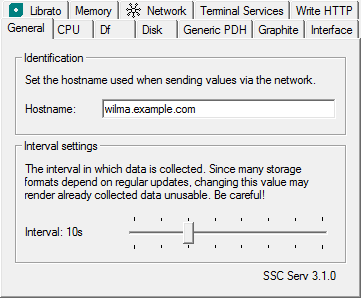
Configuration is done using the "SSC Service" applet in
the Control Panel. And, in the best of UNIX
® traditions, the daemon can be uninstalled
without any leftover files or dead registry keys clogging the system.
Intended application
Without a collectd instance running as a server on an UNIX® machine, SSC Serv doesn't make any
sense. It's more or less an outpost of collectd on a foreign system. So
the intended application clearly is to integrate Windows® machines in an existing or future collectd
setup.
SSC Serv is not collectd
Although their design and concept are similar, SSC Serv is not a
port of collectd to the Windows
® platform.
SSC Serv has been developed explicitely for the Windows
® platform and is a native Windows
® application. It does
not
need any transition layers such as
Cygwin. Also collectd is free and
open-sourced software, while SSC Serv is proprietary, commercial
and (to date) closed-source software.